The importance of properly curing concrete cannot be overstated. Appropriate, effective and practical curing ensures higher quality and durability. Today we can design concrete to last centuries - the base of Smeaton's Eddystone lighthouse in England has stood for 250 years - and durable concrete, usable by several generations, is fundamental to a sustainable future. Curing plays a key role in strength development and durability.
Design codes require execution specifications covering mixing, curing, striking and placing. The performance of the finished structure depends heavily on placing and on curing.
What is curing?
Curing starts immediately after placing (or finishing, for floors) and means maintaining suitable temperature and moisture, in the body and at the surface of the concrete, for a period of time. Properly cured concrete retains enough internal moisture to continue hydrating and gaining strength, dimensional stability, and resistance to freeze-thaw, abrasion and scaling.
When is curing needed?
Many designers and contractors wrongly believe curing is only for horizontal pours, and only in a few hot summer weeks. Compare the strength of a cube cured correctly for 28 days with a core taken from the same concrete in the structure, and the size of the problem becomes clear. Consider how pointless a specified cover depth is if the concrete cracks from lack of curing because the formwork was struck early. The answer: cure every pour.
How long?
EN 13670 defines four curing classes according to how long each element is to be protected. The designer chooses the class based on exposure class, concrete type, cover, climate and element size, and states it in the execution specification.
- Class 1: minimum 12 hours.
- Class 2 (surface reaches 35% of characteristic strength): 1-2.5 days at 25 C, up to 2-11 days at 5-10 C depending on strength development.
- Class 3 (50%): 1.5-3.5 days at 25 C, up to 3.5-18 days at 5-10 C.
- Class 4 (70%): 3-6 days at 25 C, up to 9-30 days at 5-10 C.
In other words, for maximum performance (class 4) in winter, curing must continue for at least three weeks.
The best way to cure
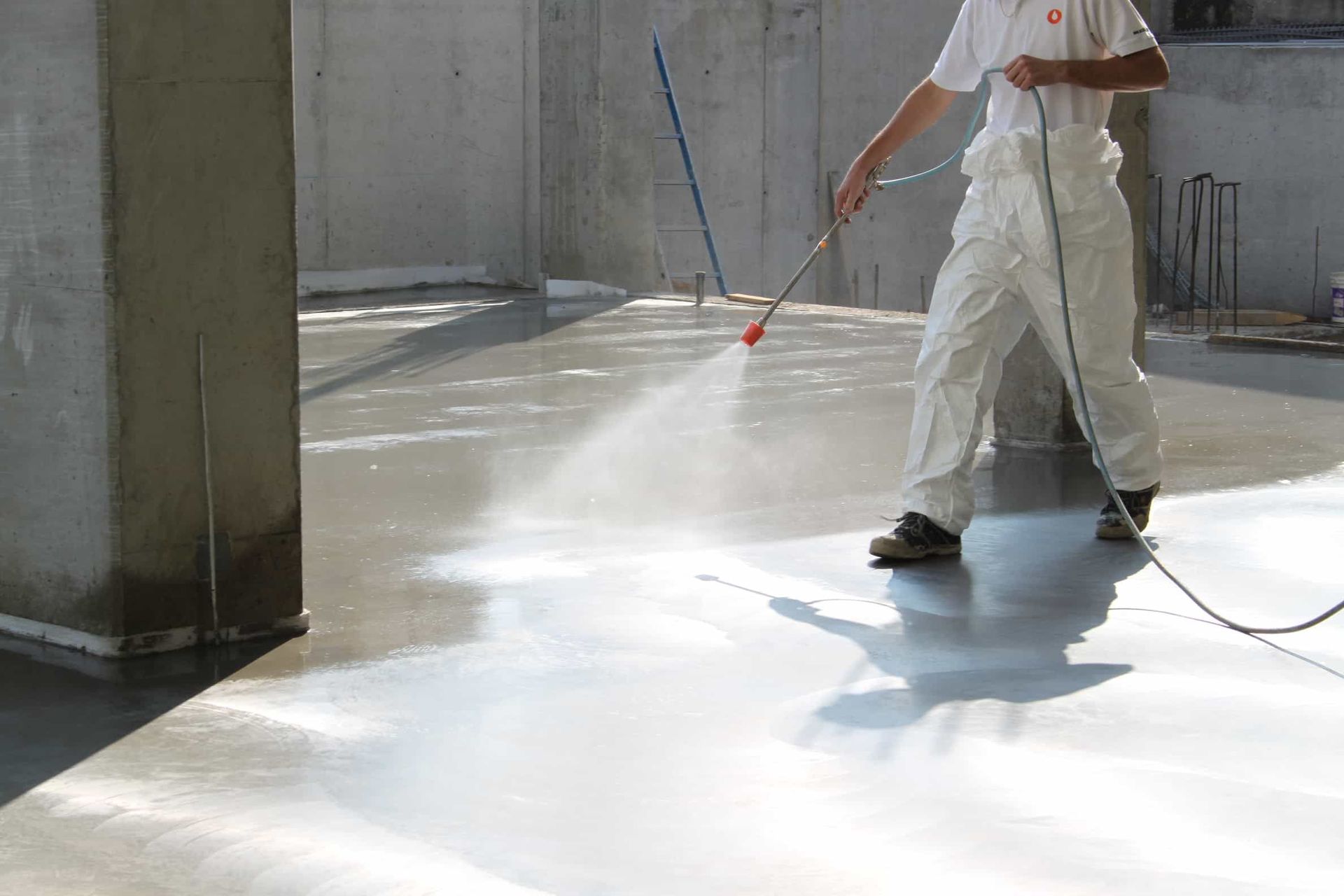
Without doubt: apply Vetrofluid immediately after striking, or Pavishield as soon as trowelling ends on a floor. Both are excellent anti-evaporation agents; sprayed on, they are the simplest and safest way to achieve prolonged curing - and the most ecological. They deliver class-4 curing summer and winter; allow subsequent finishes (linoleum, resins, mortars, parquet) without removal; are easy to apply and non-toxic; remain deep in the pour protecting concrete and reinforcement; waterproof and protect against freeze-thaw and chemical attack; and are CE marked to EN 1504-2.