Below ground, concrete has water against it for its whole life - in the soil, under pressure, rising by capillarity and arriving through every joint and tie hole. There are two very different situations: a new basement, where the outside face can be reached until it is backfilled, and an existing one, where the only face you can reach is the inside.
Why treat the concrete instead of covering it
Sheet and liquid-applied membranes work only while they stay continuous and bonded. Backfilling can damage them, ground movement stresses them, and one small defect lets water travel behind the membrane to wherever it finds a way in - often far from the defect itself.
Evercrete Vetrofluid works differently. It penetrates 10 to 40 mm into the concrete and seals the pores from within, so there is nothing on the surface to tear. On new work, the data sheet allows treated walls to be backfilled 12 hours after treatment, with no particular protective measures. And because it works inside the concrete, it can also be applied from the inside - which is what makes it useful in existing basements where the outside face can no longer be reached.
What the tests show
- 13.6 bar for ten days, no water through. SGS TEC Services tested treated concrete cylinders to CRD-C 48 (US Army Corps of Engineers) at 200 psi - roughly the pressure at the bottom of a 140 m column of water - for ten days. No measurable water passed through the specimens; when they were split, the water front had reached about 25 mm.
- Water penetration cut by three-quarters. In an Austrian test to ÖNORM B 3303 (ARP/ECV, Leoben), concrete impregnated with the original Evercrete formula was held at 1.75 bar for three days and then at 7 bar for eleven more. Average water penetration was 16 mm, against 63 mm for untreated specimens.
- Old concrete responds too. The Air Force Institute of Technology in Warsaw measured an 80% drop in water absorption on cores taken from an existing pavement after treatment - relevant when the basement is decades old.
- Water from the other side. The manufacturer's data sheet states permanent waterproofing even under negative pressure of up to 10 atm - that is, with the water pushing from the side opposite the treatment.
Laboratory results describe the samples tested. On site, performance depends on the concrete and above all on its joints, cracks and holes - which is why both methods below start with them.
New basements: treat from the outside before backfilling
- Strike the formwork and remove release-agent residue.
- Repair tie holes and honeycombing with a repair mortar such as Strutturale or Crono, and deal with any water leaks before treating.
- Detail the construction joints - wall-to-slab kicker, raft joints, lift pit - with hydrophilic waterstops. Vetrofluid treats the concrete either side of a joint, not the joint itself.
- Seal pipe and duct penetrations with sleeves, puddle flanges or compression seals.
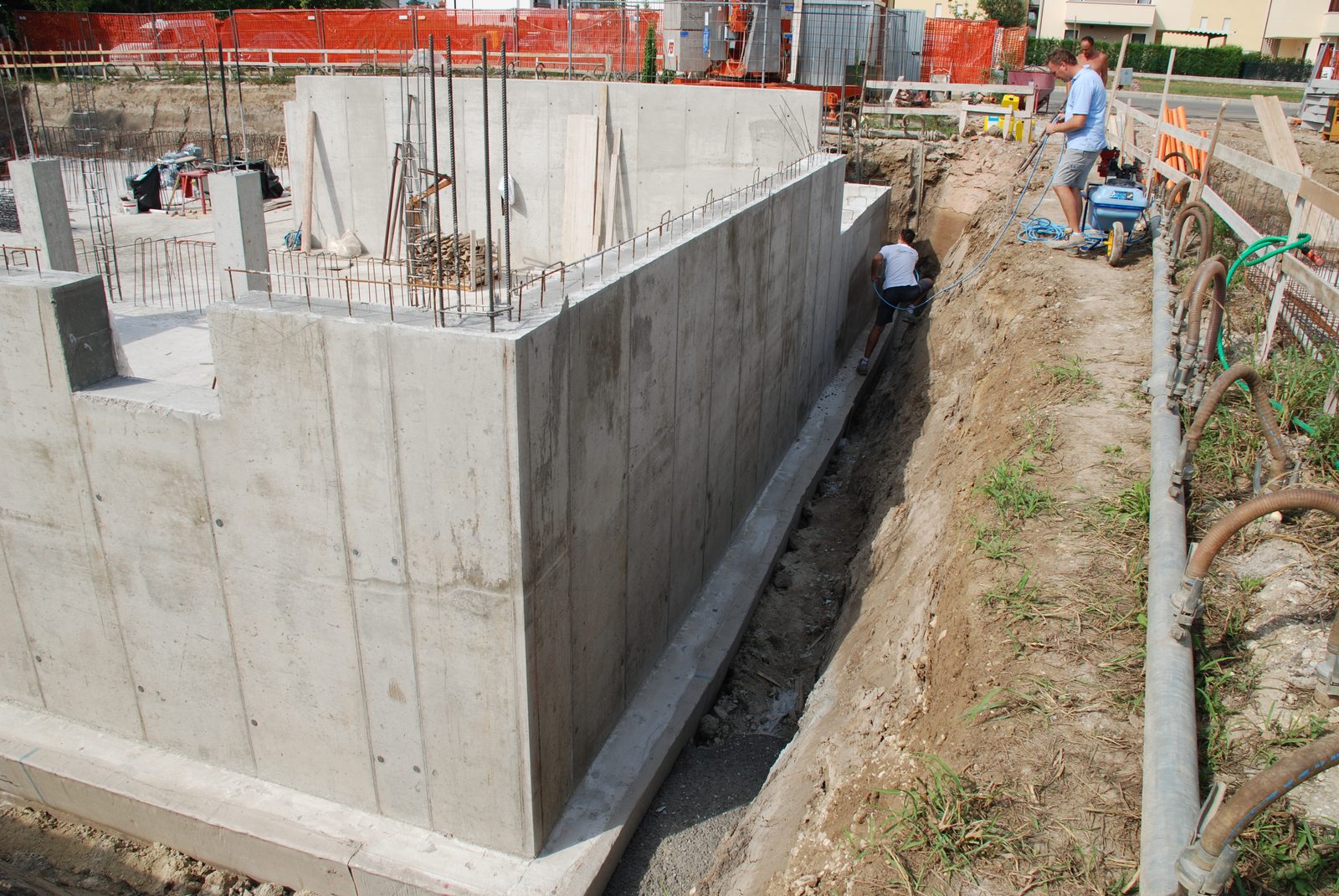
- Spray Vetrofluid with a low-pressure garden-type sprayer (maximum 5 bar), working from the bottom of the wall upwards. Apply the first coat to saturation without letting it drip, and the second once the first has dried.
- Backfill after 12 hours.
Treat the raft slab, lift pit and sump the same way: the whole below-ground concrete box is one system. Typical consumption is about 400 g/m² for both coats, and the calculator on the Vetrofluid product page works out how much you need.
Existing basements: working from the inside
When the outside face is buried, the treatment goes on the inside. The method, from the data sheet:
- Strip everything back to bare concrete - paint, plaster, render and old coatings. The silicate has to reach the concrete to work.
- Stop running leaks and repair defects first: injection for leaking cracks and joints, repair mortar for holes and broken areas.
- Wet the surface.
- Spray Vetrofluid until the concrete is saturated.
- Wait a few days, then repeat the treatment. A very wet wall may need a further repeat.
- If white efflorescence appears over the following days, remove it mechanically - brush or scrape - rather than washing it off with water under pressure.
Plaster can go back on after a few hours. Paints, resins and other finishes that need a completely dry base should wait at least 2-3 weeks, and the treatment reaches full cure in 36 days. Allow more material than for new work: a damp basement treated from the inside often needs the extra applications.
What Vetrofluid does not do
- It does not seal construction joints or movement joints. These need waterstops, injection or joint bands.
- It does not replace crack and leak repair. Active leaks and moving cracks are repaired first.
- It is a treatment for concrete. Brick and blockwork basements need a different approach.
- It is not a substitute for design. Where a basement is habitable or being converted, the waterproofing should be designed to BS 8102:2022 by a waterproofing design specialist, who sets the grade of protection and decides whether combined protection is needed. Vetrofluid can be one part of that design.
What this means for UK projects
For new basements, lift pits and underground car parks, spraying the outside of the walls is a quick operation that does not hold up the groundworks - the walls can be covered 12 hours later. For older basements, the inside method avoids excavation altogether. Either way, success is decided at the joints and penetrations: Waterproof the concrete, engineer the interruptions shows how each one is detailed, and the Fontaniva railway underpass shows 1,000 m² of walls and slab waterproofed in a single day. Contact us to talk through your basement.