Floor finishes fall into two families: those laid or glued on top (floating floors, tiles, timber, some rubber and linoleum) and those in full adhesion with the substrate (resins, trowelled cementitious finishes). The second family follows the substrate exactly - and reflects all its movements. If the screed cracks, the bonded finish cracks. On this point there is a great deal of confusion.
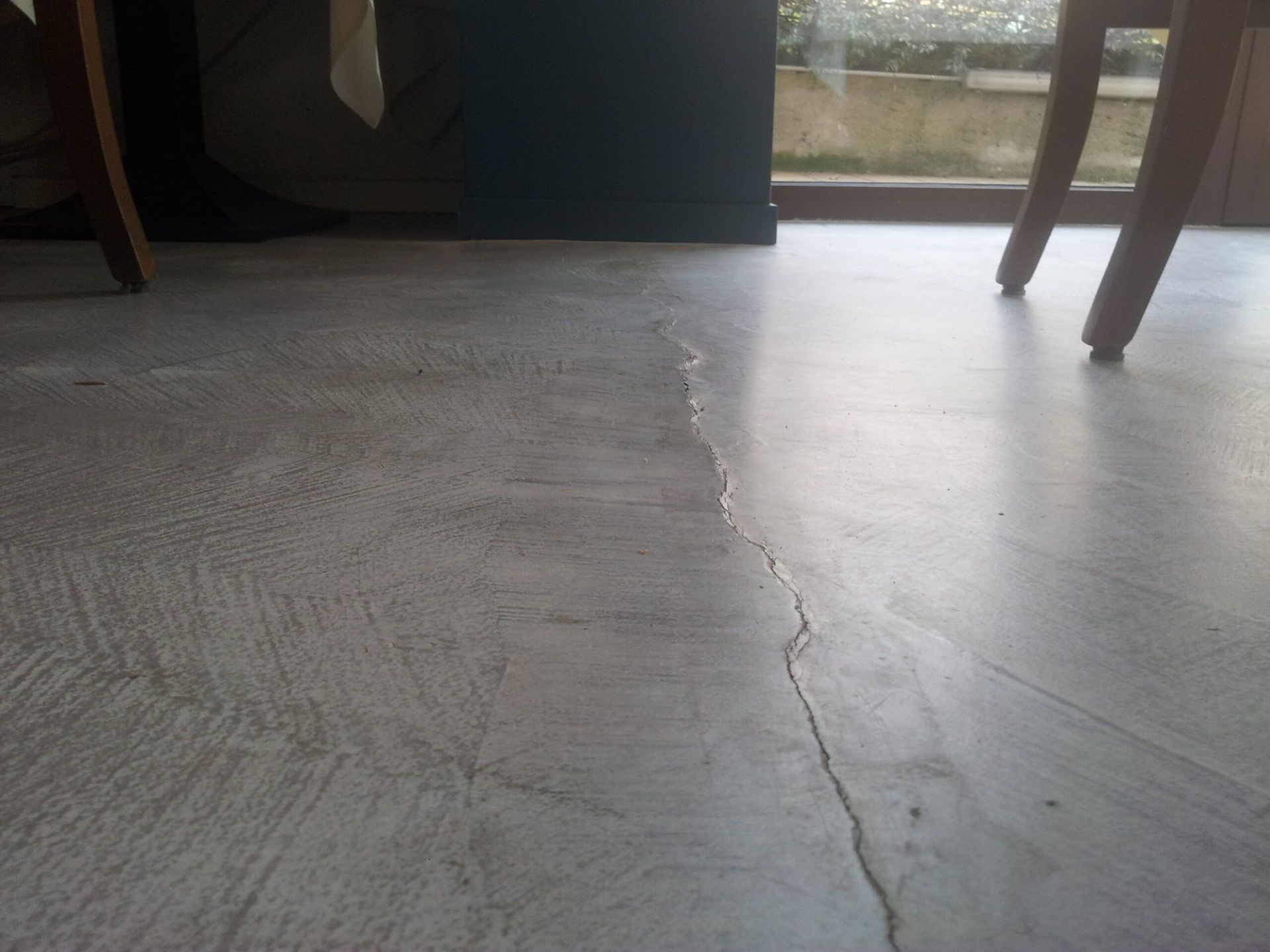
First: a crack visible in the finish is certainly the consequence of a crack in the substrate. It is the only physically possible explanation - plastic or drying shrinkage in a seamless finish is negligible.
Second: some finishes have good elasticity and can tolerate small movements - the crack-bridging ability of EN 1062-7. But it is rarely durable: sooner or later the crack shows even through very elastic finishes, especially with dynamic movement.
Four mechanisms in the substrate
- Drying shrinkage. Screeds - especially cementitious - contract as the cement shrinks; the contraction is restrained by friction and by columns and walls, and the resulting stresses crack the screed. Important mainly in the first 90 days. After three months, absent other phenomena, you can safely coat over the cracks that have formed. In a hurry? Cut control joints to guide the cracks into an orderly pattern, seal them with elastic materials (polyurethane or polysulphide) and make them part of the floor's design.
- The same, when patching: chasing for services, adding new floor to old, and so on.
- Thermal expansion - particularly with underfloor heating and outdoors. The concrete pushes on its surroundings; provide expansion joints of at least 1-2 cm. Unlike shrinkage, which fades, expansion lasts the life of the structure.
- Structural movement: on a suspended slab, or on poorly compacted ground, settlement and unexpected movement crack the substrate. Include here everything buried in screeds - pipes, services, gullies and channels - and adventurous geometries with corners and changes of section.
The substrate plays the fundamental role: assess its type, geometry and curing time scrupulously. Shortcuts only raise the risk of blemishes that are sometimes irreparable. Give your finish the support it deserves - and for substrate checks see our substrate preparation guide.
See finished projects and the full UK microcement range on our microcement floors and walls page.